7 Tips for Buying Used Stair Lifts
Buying Used Stair Lifts can make safer movement between floors more affordable, but a low price alone proves little. The rail must suit the staircase, the seat must feel secure, and the controls must be easy to reach. A lift that looks clean in a seller’s photo may still have worn batteries or missing service records. Small details matter.
Mobility-equipment specialist Daniel Mercer offers this practical reminder: “A used stair lift is a good buy only when its fit, condition, and service history are checked together.” Treat that as a starting point, not a substitute for an in-person assessment. Ask for the make, model, age, serial number, maintenance records, and any warranty details. Have a qualified professional confirm that the rail matches your stairs and that the unit can be safely installed and tested. A neat rail is not proof of a sound lift.
This guide introduces seven tips for checking compatibility, inspecting condition, comparing costs, and arranging professional installation. It also looks at batteries, repairs, and questions to ask before paying. Some used lifts offer real value. Others need parts, labor, or modifications that change the price completely. And even a careful checklist can miss something. That is why an independent assessment is worth considering before you commit.
Assess Mobility Needs and Staircase Layout
Assess Mobility Needs and Staircase Layout
Before looking at a used stair lift, consider how the rider moves through a typical day. Can they sit down and stand up safely, or do they need help with transfers? Note balance, grip strength, fatigue, and whether these needs may change. Small details matter. A mobility professional can help assess safe transfers and seating needs; don’t rely on a quick glance at the stairs alone.
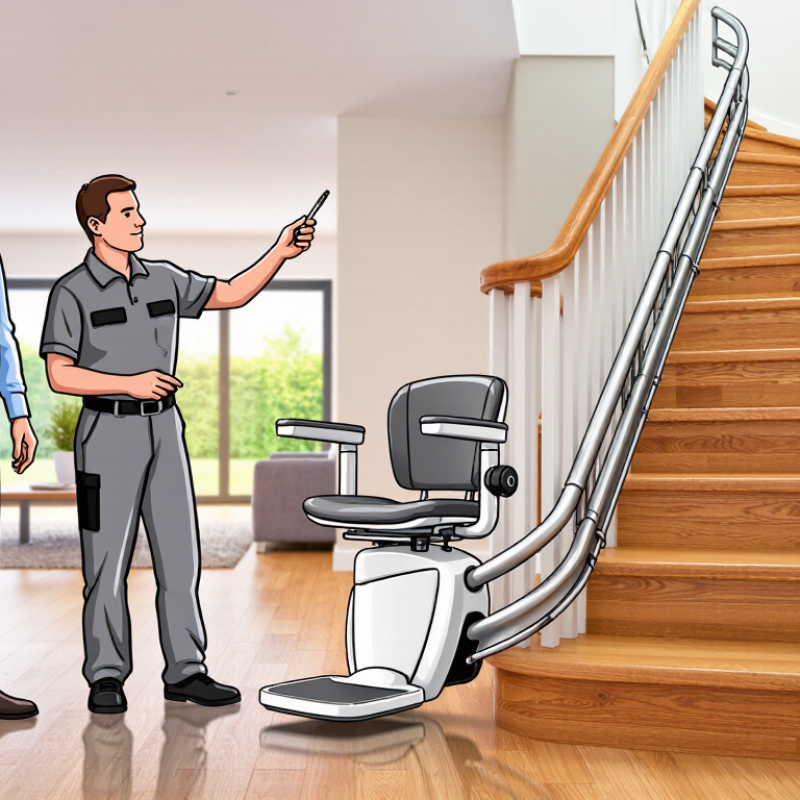
Measure the staircase, including its narrowest point, turns, landings, and nearby doorways. Check whether the lift would block a route people use every day. A curved track made for another staircase may not fit yours, even if the stairs look similar. Measure twice. Photos can miss awkward corners, so an experienced installer should inspect the layout in person before you buy.
Also consider where the seat will stop and how the rider will get on and off. A chair that parks neatly at the top may still obstruct a doorway. Check the lift’s charging position and ask a qualified technician to confirm that its track and components suit the staircase and are in serviceable condition. It’s easy to focus on price and overlook the landing. I might, too.
Select a Compatible Lift Type and Track Configuration
A used stair lift must fit the staircase, not just the buyer’s budget. Measure the full stair run, width, landings, and space at both ends. A straight rail suits one continuous flight. A staircase with a turn or intermediate landing usually needs a curved rail, built to match its specific geometry. Similar-looking stairs are not enough. Curved tracks are rarely interchangeable.
Check the lift type and every track component together. Confirm the carriage, rail, seat, controls, and charging points are compatible with the exact model. Ask for installation records and have a qualified stair-lift technician inspect wear, movement, and safety features. Don’t guess here. A rail that ends too close to a doorway can obstruct access, while a folded seat may still narrow a tight hallway.
AARP’s 2024 Home and Community Preferences Survey found that 75% of adults aged 50 and older want to remain in their homes as they age. The CDC reports that about one in four adults aged 65 and older falls each year. These figures support careful home-access planning, but they do not show that a lift prevents falls. Consider the user’s transfer ability, preferred side of travel, and whether controls are reachable while seated. I may be overlooking a detail: the household’s daily routine can matter as much as the stair measurements.
Inspect the Lift’s Age, Condition, and Safety Features
When buying a used stair lift, ask for its age, installation date, and service records. Age alone does not prove a lift is unsafe, but missing records make its history hard to verify. Look for frayed wiring, cracked plastic, rust, loose rails, or unusual movement during a supervised test. A little wobble matters.
Check that the seat belt, swivel lock, footrest sensor, and obstruction sensors work as intended. Run the lift along the full rail and listen for grinding or sudden stops. Test the controls at both ends, too. The ASME A18.1 safety standard covers stairway chairlifts; a qualified technician can assess whether an older unit meets applicable requirements and can be safely reinstalled. Do not rely on appearance alone.
Safety deserves this attention. The CDC reports that more than 14 million U.S. adults aged 65 and older fall each year—about one in four, according to its older-adult falls data. A stair lift cannot prevent every fall, and it should not replace careful transfers or a clear staircase. Ask a technician to inspect the battery, charger, track, and safety features before purchase. Get any needed repairs in writing. If the seller cannot provide access for an inspection, pause the deal.
Verify Refurbishment, Installation, Warranty, and Service Support
7 Tips for Buying Used Stair Lifts
Verify Refurbishment, Installation, Warranty, and Service Support
AARP’s 2024 Home and Community Preferences survey found that 75% of adults aged 50 and older want to remain in their homes as long as possible. A used stair lift may help, but condition matters more than a fresh coat of paint. Ask for a written refurbishment record showing which parts were inspected, replaced, or reused. Check the seat belt, controls, footrest sensor, battery, and emergency stop. Small details matter. If the seller cannot explain a fault or provide service records, treat that uncertainty as a real cost.
Have a qualified installer measure your staircase before you buy. Curved rails are often made for a specific stairway, and even straight rails need a careful fit. Ask who will install the lift, test its safety features, and show you how to lower or stop it during a power failure. Request the warranty in writing. Confirm its term, covered parts, labor costs, and whether it transfers to a new owner. ASME A18.1 provides safety requirements for platform lifts and stairway chairlifts; ask whether the unit and installation meet applicable requirements. Also confirm local service availability and expected response times. A low price can feel reassuring. It may not stay low if a repair takes weeks.
Compare Total Costs with New and Alternative Options
When comparing a used stair lift with a new one, compare the full installed cost, not just the listing price. Angi’s stair lift cost guide estimates new installations at roughly $2,000 to $15,000, depending on stair shape and features. A used unit may cost less upfront, but ask for separate quotes for rail compatibility, removal, delivery, installation, batteries, and repairs. A curved rail cut for another staircase may not fit yours. Get the answer in writing.
Check the warranty, service history, safety sensors, and whether replacement parts are available. Then compare both quotes with alternatives: adding secure handrails and brighter lighting, moving a bedroom downstairs, or installing a ramp where access is the main issue. These options solve different problems, so price them against the actual daily barrier. Medicare generally does not cover home modifications such as stair lifts; confirm coverage before budgeting. A lower purchase price can still become the costlier choice.
There is a safety reason to weigh the alternatives carefully. The CDC reports that more than 14 million older adults fall each year, and falls lead to about 3 million emergency department visits. AARP’s 2024 Home and Community Preferences Survey found that 75% of adults aged 50 and older want to remain in their homes as they age. Those figures do not prove a stair lift is right for any one household. Measure the staircase, watch the user manage the steps, and compare written estimates. Estimates can miss things.
7 Tips for Buying Used Stair Lifts: Compare First-Year Costs
Illustrative U.S. cost ranges in USD for planning purposes. Actual prices vary by location, stair layout, equipment condition, installation, and rental terms.
How to compare: Check whether a used lift fits your staircase and includes safe installation, a warranty, and replacement-part support. Compare the full first-year cost—not just the purchase price—with new equipment, rental fees, and alternatives such as a modular ramp. Get itemized local quotes before deciding.